|
Home >
About Me > Breaking Down Barriers...
Breaking down Barriers - Institute Aims to Expose Teens to Different
Viewpoints
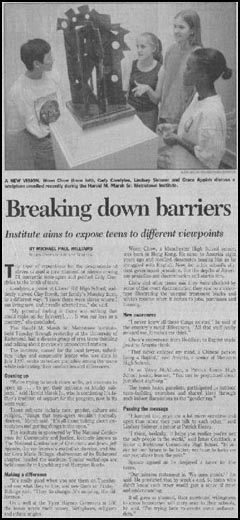
Photo Caption: A NEW VISION. Woon Chow (from left),
Cady Condyles, Lindsey Skinner and Grace Appish discuss a sculpture unvailed
recently during the Herold M. Marsh Sr. Metrotown Institute.
The topic of reparations for the descendants of slaves caused a rare
moment of silence among 51 energetic teen-agers and pushed Cady Condyles
to the brink of tears.
Condyles, a junior at Clover Hill High School, suddenly viewed Clay Brook,
her family's Moseley farm, in a different way. "I know there were slaves
where I am living now, and it really affected me," she said.
"My personal feeling is there was nothing that could make up for [slavery]....
It was our loss as a country," she concluded.
The Harold M. Marsh Sr. Metrotown Institute, held Tuesday through yesterday
at the University of Richmond, had a diverse group of area teens thinking
and talking about previously unpondered matters.
The institute, named for the local lawyer, substitute judge and community
leader who was slain in July 1997, seeks to reduce prejudice among the teens
while celebrating their similarities and differences.
Opening up
"We're trying to break down walls, get students to open up..., to get
their opinions on touchy subjects," said Harold Marsh Jr., who is continuing
his father's tradition of support for the program, now in its sixth year.
Those subjects include race, gender, culture and religion, "things that
teen-agers wouldn't normally discuss," Marsh said. "It's all about talking
about stereotypes and getting things in the open."
The institute is sponsored by The National Conference for Community and
Justice, formerly known as The National Conference of Christians and Jews.
Jeff Spence, the conference's executive director, and Sister Cora Marie
Billings, chairwoman of its Richmond chapter, headed the institute. Similar
workshops are held annually in Lynchburg and Hampton Roads.
Making a difference
"It's really good when you see them on Tuesday, and see what they're
like, and see them on Friday," Billings said. "They do change. It's amazing,
the difference."
On a wall at the Tyler Haynes Commons at UR, the teens wrote their names,
birthplaces, religions and ethnic origins.
Woon Chow, a Manchester High School senior, was born in Hong Kong. He
came to America eight years ago and recalled classmates teasing him as struggled
with English. Now, he is his school's student government president. But
the depths of American prejudice and discrimination still startle him.
Chow and other teens said they were shocked by some of the overt discrimination
they saw on a videotape illustrating the unequal treatment blacks and whites
receive when it comes to jobs, purchases and housing.
New awareness
"I never knew all these things existed," he said of the country's racial
differences. "All that stuff really amazed me. It makes me think."
Chow's conversion from Buddhist to Baptist made Jesstina Arnette think.
"That never entered my mind, a Chinese person being a Baptist," said
Arnette, a senior at Monacan High School.
Or as Vince McAllister, a Patrick Henry High School junior, learned,
"You can be prejudiced about just about anything."
The teens heard panelists, participated in outdoor team-building exercises
and shared ideas through such indoor discussions as the "gender rap."
Passing the message
"I learned that guys are a lot more sensitive and open than when they
just talk to each other," said Lindsey Skinner, a junior at Patrick Henry.
"I think, basically, it helps you realize you're not the only people
in the world," said Janae Craddock, a junior at Richmond Community High
School. "In order for our future to be better, we have to focus on our prejudices
from the past."
Spence agreed as he deejayed a dance for the teens.
"Our mission statement is, 'We open minds,'" he said. He predicted that
by week's end, 51 teens who didn't know each other would gain a sense of
trust and understanding.
If all goes as planned, their newfound willingness to cross boundaries
will carry over to their schools, he said. "I'm trying here to create some
ambassadors."
Williams, Michael Paul. "Breaking down Barriers."
Richmond Times-Dispatch 15 Aug. 1998: B5.
Home >
About Me > Breaking Down Barriers...
|